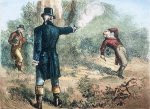


By Tweed
In my last post on the Constitution, I briefly described the history of the adoption of the Constitution. In this post I will briefly describe how the Constitution found its biological parents.
The Constitution is chock full of nifty concepts and rules. There is the "balance of power" concept, the "checks and balances" concept and the "Great Sandini Balancing Act" concept. All of these concepts are buried deep within the text of the Constitution, which has guaranteed their departure into the world of irrelevance and obscurity.
Welcome to the World of Irrelevance and Obscurity.
Part I - The Executive Branch
The Executive Branch of the Federal government is described in Article II of the Constitution, but it has nicer bathrooms than the branch of government described in Article I. Article II provides that the executive power of the United States is vested in the President. This gives the President the authority to enforce the laws of the country, spare one Turkey from the oven each Thanksgiving and not get out of bed to go to work.
The President is empowered to make deals with foreigners, subject to Senate approval. This makes the United States a lot like that nerdy kid you grew up with who had to check with his mom before he could do anything (and she usually said no). Historically, presidents have attempted to circumvent Senate oversight, usually without much success. In 1852, for example, President Filmore tried to enter a trade pact with Spain by pretending to be sick and signing the pact when the Senate went to work that morning. But the Senate found out that evening, and punished the President by re-naming him Millard. Over time, presidents have gained the trust of the Senate, which has rewarded the president with greater freedom of action in foreign affairs under special circumstances, such as when Britney Spears is performing at the Albert Hall.
There's also a Vice President, who gets to bust prostitutes and gamblers.
Part II - The Legislative Branch
The Legislative Branch is described in Article I of the Constitution and consists of two houses, both alike in dignity, in swampy Washington, where we lay our scene. The House of Representatives is larger than the Senate, and consists of 439 representatives, 4,874 staffers and 25,773 interns. The House of Representatives is famous for being the only house of the Legislative Branch with the word "house" in its title. It also makes a great barbecue sauce.
The Senate, consisting of 97 Senators, 7,984 staffers and 487,933 interns, used to be the more dignified house, until the senior Senator from Ohio began making fart noises whenever his colleagues sat down. It is now considered to be closer alligned with the mood of the people.
The chief job of the legislative branch of government is to right the law - an important function, because the law is prone to frequent capsizing.
Part III - The Judicial Branch
The Judicial Branch of government is the Supreme Court and is described in Article III of the Constitution. The Supreme Court is the highest court in the land, which explains the massive orders for pizza and potato chips from the Supreme Court building. The Justices of the Supreme Court hold court in the their hands or in the Halls of Justice. The current members of the Supreme Court are Superman, Wonder Woman, Batman, Robin, Aqua Man, the Flash, the Green Lantern and the Wonder Twins.
The Supreme Court's function is to interpret the Constitution. This is a very difficult job, because there are many theories on how the Constitution should be interpreted. Conservatives generally prefer the Constitution with some fiddle and spoon slapping, while most liberals prefer a dance beat and some sythesizers. Strict constructionists prefer theirs with a strings and light woodwinds.
Part III - Make Law, Not War
Correct me if I'm wrong, but both houses of the Legislative Branch must vote to pass a law. Every law starts as a bill, only a bill, sitting there on capital hill. Bills usually end up in committee, along with everything else known to humanity. Occasionally, some things pop out of committee - like yesterday, when old Ms. Schuyler's shawl that she lost on her trip to Washington back in 87' popped out of the House Sub-Committee on Frozen Waffles and Urban Infrastructure.
Once out of committee, everyone gets to attach ryders to a bill. By law, each ryder must (a) be wholly unrelated to the bill to which it is attached, and (b) be designed to either (i) destroy any chance the bill has in being approved or (ii) give a congressman's girlfriend $400,000 to build a beutician museum in downtown Akron. Once a bill is sufficiently weighted down with ryders (the Constitution requires at least 36 ryders), the bill is thrown into a large body of water, traditionally, the Potomac river. If it floats, it passes; but if it sinks, it was never a good idea to begin with.
If the bill floats, it is immediately presented to the President for drying. If the President likes the bill, he signs it and it becomes law. If he doesn't like it, he throws it back into the Potomac.
But here's the big problem: we have to wait for a controversy before the Supreme Court weighs in on any law's constitutionality. Here's an idea - what if Congress or the President could just ask before hand and save everyone some time?
Part IV - The Great Sandini Balancing Act
The founders of the Constitution understood the importance of balance. Accordingly, laying in wait for the unwary are a series of balancing acts.
Until the adoption of the 17th Amendment, the principle of the "balance of power" required that, at all times, the weight of the President and his cabinet had to be within five pounds of 75% of the aggregate weight of the members of the Supreme Court and within 15 pounds of the combined weight of the members of congress divided by 13 - which explains why Grover Cleveland's cabinet consisted of two midgets and a slight gay British national and Howard Taft's cabinet was made of balsa wood.* But this concept became cumbersome (no pun intended).
With the advent of the 17th amendment, the "balance of power" was dropped and quickly replaced by the "checks and balances" concept before anyone could get a good look at the Constitution naked. The checks and balances concept requires that upon assuming the office of President, the President's wealth must be equal to or greater than 40% of the wealth of the aggregate wealth of the members of the Supreme Court and equal to or less than the combined wealth of the five richest members of Congress. In the event that this requirement is not met, the President, members of the Supreme Court or members of Congress, as the case may be, write a series of checks until the proper balance is achieved (hence the name of the concept).
Tune in next time, as we discuss the Consitution's first date - the Bill of Rights.
* During Taft's tenure on the Supreme Court there was a mad rush to create additional cabinet posts to achieve balance, which explains the short lived, but much sought after post of Secretary of Chocolate Ice Cream.
Saturday, September 10, 2005


Sunday, August 28, 2005
PRECEDENT
Precedent: it's a word First Year law students hear often. You may hear Second and Third year students say, "It's bad precedent," or a professor may say, "Will this decision make good precedent?"*
PRECEDENT: WHAT IS IT AND WHAT IS IT GOOD FOR?
When a court looks to precedent, it looks to see how other courts have decided the issue that is presently before them. If other courts have consistently held that certain contracts must be in crayon, then a precedent has been set and the court has to do little work in rendering a decision. They merely have to write, affirmed. It's judicial time saving at its finest.
Ideally, for precedent to be at its strongest, your case should be on "all fours" with the precedent case. This is not as fun as it sounds, even in mixed company. It simply means that the facts of your case are identical to the facts of the precedent case.
Precedent-setting cases generally stand for a particular rule of law. Often times, there is more going on in these cases than a mere legal dispute. The diligent student will study the more important precedents and know when to use them. The less diligent student will have a social life. Here are some of the more well-known precedents you'll need to know.
MARBURY V MADISON (1803)
Facts: Then Secretary of State James Madison refused to deliver certain commissions to their intended recipients because it was very late at night and he had a big day ahead of him, thereby denying the intended recipients their rightful patronage jobs and government pensions.
What it stands for: The Supreme Court can declare an act of Congress unconstitutional.
What it really stands for: John Marshall established the Judiciary as a co-equal branch of government and established judicial review over congressional acts while simultaneously annoying his cousin, President Jefferson.
UNITED STATES V BURR (1807)
Facts: The former Vice-President was arrested for treason for allegedly planning to separate the western states from the eastern states and then reattaching them with epoxy.
What it stands for: Treason requires two witnesses, an overt act and something to betray.
What it really stands for: Killing a former Treasury Secretary is one thing, pissing off Jefferson twice in one decade is a bad move.
PACKARD V PACKARD (1864)
Facts: Under Illinois Law a man could institutionalize his wife "without the evidence of insanity required in other cases."
What it stands for: No person can be restrained against their will absent some minimal level of evidence of incompetence. Not even a woman.**
What it really stands for: Officially ended "The Good Old Days" for men everywhere.
SCHENCK V US (1919)
Facts: The Socialist Party circulated pamphlets critical of U.S. conscription in violation of the 1917 Espionage Act.
What it stands for: You can't falsely shout fire in a crowded theater.
What it really stands for: Your right to yell theater in a crowded firehouse is absolute, absent a compelling state interest.
ROE V WADE (1973)
Facts: Roe*** challenged a Texas statute that criminalized abortion.
What it stands for: A woman's right to her body has some level of Constitutional protection. The viability of the fetus is also a factor as pointed out by Justice White: "A fetus is a fetus until it gets out of medical school."
What it really stands for: The President can deploy troops to any womb that poses a security threat to the United States but if the occupation is to exceed 90 days he must seek congressional approval.
CALIFORNIA V PETERSON (2005)
Facts: A husband is found guilty of murdering his wife despite the lack of any direct evidence linking him to the murder.
What it stands for: A criminal conviction may be upheld when based soley on circumstantial evidence.
What it really stands for: First time a California court finds a defendant guilty of murder.
Other precedent-setting cases the new law student should know about:
Spy v. Spy (also involves the 1917 Espionage Act);
Kramer v. Kramer (Stars Dustin Hoffman);
Ali v. Foreman
Joe v. The Volcano
* Precedent comes from the Latin, meaning "What he said."
** A woman is a person under Illinois law
***Roe was an alias. Roe's real name was Doe.
PRECEDENT: WHAT IS IT AND WHAT IS IT GOOD FOR?
When a court looks to precedent, it looks to see how other courts have decided the issue that is presently before them. If other courts have consistently held that certain contracts must be in crayon, then a precedent has been set and the court has to do little work in rendering a decision. They merely have to write, affirmed. It's judicial time saving at its finest.
Ideally, for precedent to be at its strongest, your case should be on "all fours" with the precedent case. This is not as fun as it sounds, even in mixed company. It simply means that the facts of your case are identical to the facts of the precedent case.
Precedent-setting cases generally stand for a particular rule of law. Often times, there is more going on in these cases than a mere legal dispute. The diligent student will study the more important precedents and know when to use them. The less diligent student will have a social life. Here are some of the more well-known precedents you'll need to know.
MARBURY V MADISON (1803)
Facts: Then Secretary of State James Madison refused to deliver certain commissions to their intended recipients because it was very late at night and he had a big day ahead of him, thereby denying the intended recipients their rightful patronage jobs and government pensions.
What it stands for: The Supreme Court can declare an act of Congress unconstitutional.
What it really stands for: John Marshall established the Judiciary as a co-equal branch of government and established judicial review over congressional acts while simultaneously annoying his cousin, President Jefferson.
UNITED STATES V BURR (1807)
Facts: The former Vice-President was arrested for treason for allegedly planning to separate the western states from the eastern states and then reattaching them with epoxy.
What it stands for: Treason requires two witnesses, an overt act and something to betray.
What it really stands for: Killing a former Treasury Secretary is one thing, pissing off Jefferson twice in one decade is a bad move.
PACKARD V PACKARD (1864)
Facts: Under Illinois Law a man could institutionalize his wife "without the evidence of insanity required in other cases."
What it stands for: No person can be restrained against their will absent some minimal level of evidence of incompetence. Not even a woman.**
What it really stands for: Officially ended "The Good Old Days" for men everywhere.
SCHENCK V US (1919)
Facts: The Socialist Party circulated pamphlets critical of U.S. conscription in violation of the 1917 Espionage Act.
What it stands for: You can't falsely shout fire in a crowded theater.
What it really stands for: Your right to yell theater in a crowded firehouse is absolute, absent a compelling state interest.
ROE V WADE (1973)
Facts: Roe*** challenged a Texas statute that criminalized abortion.
What it stands for: A woman's right to her body has some level of Constitutional protection. The viability of the fetus is also a factor as pointed out by Justice White: "A fetus is a fetus until it gets out of medical school."
What it really stands for: The President can deploy troops to any womb that poses a security threat to the United States but if the occupation is to exceed 90 days he must seek congressional approval.
CALIFORNIA V PETERSON (2005)
Facts: A husband is found guilty of murdering his wife despite the lack of any direct evidence linking him to the murder.
What it stands for: A criminal conviction may be upheld when based soley on circumstantial evidence.
What it really stands for: First time a California court finds a defendant guilty of murder.
Other precedent-setting cases the new law student should know about:
Spy v. Spy (also involves the 1917 Espionage Act);
Kramer v. Kramer (Stars Dustin Hoffman);
Ali v. Foreman
Joe v. The Volcano
* Precedent comes from the Latin, meaning "What he said."
** A woman is a person under Illinois law
***Roe was an alias. Roe's real name was Doe.
Friday, August 12, 2005
AN INSIDE LOOK AT THE SUPREME COURT
By Stockton
Most insider books and interviews are written by powerful people and give us an inside look at the world of the powerful. This holds true for the Supreme Court, where we are fed a constant diet of tell-all books, usually penned by clerks to the judges.
Fortunately, we recently unearthed an interview of Samuel "Chum" Hubbs, the Supreme Court Barber from 1899 to 1966. Mr. Hubbs comes across as a charming, loquacious man and proved to be a wealth of information. The interview was conducted in 1969, a few years after he resigned from his position. Mr. Hubbs died in 1978. The following are excerpts from that interview.
"Sure, I cut Holmes' hair. I cut them all, Holmes, Brandeis, Cardoza. Came from a long line of barbers. Dad was a barber, his father was and his grandfather was. My brother too. Old Nat cut hair for the Massachusetts Supreme Court. Got appointed to the 1st Circuit even, back in '31 or '32. Then the bottom fell out of the Barbisol market and he lost everything.
"McReynolds....sure, I cut his hair. Strange man, McReynolds. He had gone almost entirely white when he came to the court but still had some black strands. He insisted that I always separate the black hairs and white hairs. 'Make them equal lengths, Chum,' he'd say. "But make sure they're separated.' I remember McReynolds always got his hair cut on Sunday. Brandeis and Cardoza always came in on Saturday. That made McReynolds crazy. Said I should close up shop early on Saturdays and make them two go somewhere else.
"Brandeis was a good customer. Exacting, but good. Always came in with charts, studies and diagrams showing me why his hair grew like it did. That it was the environment he grew up in, that if he had grown up in different circumstances, his hair might be different. That's why Brandeis' hair style seems to change. I had to change it everytime there was a new study or poll.
Yeah, I was there through the War Years. Those were tough times for everyone and the court was no different. Black came in one day, sometime in '42 or late '43. He wanted me to cut certain hairs from his head and put them aside, in a special container. "Just until this is over, Chum," he said. "We can replace them after it's over." He asked me to keep an eye on those hairs until hostilities ceased. I shook my head. "But Judge, these are your hairs, grew right here out of your scalp." He smiled at me. "We're at war, Chum and good grooming habits aren't a suicide pact." That last part he stole from Justice Jackson.
"You heard of the Court Packing plan? I was instrumental in killing that idea. I was in my shop one day and who walks in? Franklin Delano Roosevelt himself. "Chum," he says, "I have an idea. You think you could handle four more appointments a week?" I just shook my head in disbelief. My appointment book was already filled up for an entire year. There was no way I could handle anymore. That's how the court packing plan got killed.
"My favorite customer? Justice Holmes. He was a charming man and a good tipper. We got to be pretty friendly too. Everytime Ollie walked in I'd shout, "Fire, fire!" He'd pretend to panic and we'd have a good laugh. Douglas was a favorite too. Willy O. would walk in and say, "I need a hair cut, Chum." I always replied, "Just one?" That was our little joke. Then he'd say, "No, cut the whole penumbra." Penumbra, never did understand that one.
"Regrets? Just one. I would have liked to get my hands on O'Connor or Ginsburgh. I think ol' Chum here could have helped them quite a bit."
Most insider books and interviews are written by powerful people and give us an inside look at the world of the powerful. This holds true for the Supreme Court, where we are fed a constant diet of tell-all books, usually penned by clerks to the judges.
Fortunately, we recently unearthed an interview of Samuel "Chum" Hubbs, the Supreme Court Barber from 1899 to 1966. Mr. Hubbs comes across as a charming, loquacious man and proved to be a wealth of information. The interview was conducted in 1969, a few years after he resigned from his position. Mr. Hubbs died in 1978. The following are excerpts from that interview.
"Sure, I cut Holmes' hair. I cut them all, Holmes, Brandeis, Cardoza. Came from a long line of barbers. Dad was a barber, his father was and his grandfather was. My brother too. Old Nat cut hair for the Massachusetts Supreme Court. Got appointed to the 1st Circuit even, back in '31 or '32. Then the bottom fell out of the Barbisol market and he lost everything.
"McReynolds....sure, I cut his hair. Strange man, McReynolds. He had gone almost entirely white when he came to the court but still had some black strands. He insisted that I always separate the black hairs and white hairs. 'Make them equal lengths, Chum,' he'd say. "But make sure they're separated.' I remember McReynolds always got his hair cut on Sunday. Brandeis and Cardoza always came in on Saturday. That made McReynolds crazy. Said I should close up shop early on Saturdays and make them two go somewhere else.
"Brandeis was a good customer. Exacting, but good. Always came in with charts, studies and diagrams showing me why his hair grew like it did. That it was the environment he grew up in, that if he had grown up in different circumstances, his hair might be different. That's why Brandeis' hair style seems to change. I had to change it everytime there was a new study or poll.
Yeah, I was there through the War Years. Those were tough times for everyone and the court was no different. Black came in one day, sometime in '42 or late '43. He wanted me to cut certain hairs from his head and put them aside, in a special container. "Just until this is over, Chum," he said. "We can replace them after it's over." He asked me to keep an eye on those hairs until hostilities ceased. I shook my head. "But Judge, these are your hairs, grew right here out of your scalp." He smiled at me. "We're at war, Chum and good grooming habits aren't a suicide pact." That last part he stole from Justice Jackson.
"You heard of the Court Packing plan? I was instrumental in killing that idea. I was in my shop one day and who walks in? Franklin Delano Roosevelt himself. "Chum," he says, "I have an idea. You think you could handle four more appointments a week?" I just shook my head in disbelief. My appointment book was already filled up for an entire year. There was no way I could handle anymore. That's how the court packing plan got killed.
"My favorite customer? Justice Holmes. He was a charming man and a good tipper. We got to be pretty friendly too. Everytime Ollie walked in I'd shout, "Fire, fire!" He'd pretend to panic and we'd have a good laugh. Douglas was a favorite too. Willy O. would walk in and say, "I need a hair cut, Chum." I always replied, "Just one?" That was our little joke. Then he'd say, "No, cut the whole penumbra." Penumbra, never did understand that one.
"Regrets? Just one. I would have liked to get my hands on O'Connor or Ginsburgh. I think ol' Chum here could have helped them quite a bit."
Monday, August 01, 2005
YOUR DUTY TO THE COMMUNITY
By Stockton
Many professionals, including lawyers, are active in the community. A surprising number of firms are proud of their community involvement and urge their new associates to "give something back to the community." So, don't be surprised if during the first few weeks of your employment, you receive a knock on your door. It will be a partner and that partner will encourage you to become involved in some community related, charitable activity.
You will have one of two responses: "Give something back to the community? Sure! Great! Since the community is paying my student loans, since the community just spent three years in school, since the community is working this lousy, 12 hour a day, slave-wage job, I'll give something to the community. How about the finger?" Make sure that this response comes from your "inner" voice and your "inner" voice only.
Instead, muster all your energy into a feigned look of interest and say, "Great, I have two or three free hours every week. I'd love to help."
There is a wide variety of community groups, activities and projects you can participate in to keep your employers happy. Here are just a few.
Battered Women
Before you jump into this, make sure you know what you're dealing with. Despite the name, this has nothing to do with smearing pancake mix onto females. In this context battered means violence, not a pasty mixture used to make pancakes or fish fries. Battered women's advocacy groups can always use free legal counseling on a wide variety of issues. It is a worthy endeavor but proceed with caution when selecting a group. If you decide to do pro bono work for a battered women's group, make sure it's an anti-battered women's group. I learned that one the hard way.
Youth Groups
A partner at my firm was able to combine his love of basketball and his desire to work with inner-city street gangs. When he was finished, he had turned four inner-city youth basketball teams into street gangs. Quite a success rate. The street gangs are now 7-0 this season and are heading to the state finals.
Indigent Teens
Another partner spends his spare time working with indigent teens. He says many of those teens just need someone who will listen. He is very dedicated to this work. On weekend nights, when I'm out late, I often see his car parked in a disreputable neighborhood. He must be well-liked though, because I usually see young females leaning in his passenger window listening to his advice. Once, I even saw him give someone some money and a ride. He has a big heart and I still don't understand why he's been divorced four times.
Indigent Lawyers
It's a little known fact but some lawyers can fall on hard times. There's nothing more worthwhile than to aid the needy within your own profession. It's a heart-wrenching experience to see a lawyer that has lost his second Mercedes or the summer home on Lake Watchamacallit in Vermont. Others become overwhelmed by their success, suffering from anxiety when they have to choose a particular tax shelter to protect their money from the government. Alcohol is another problem area for some attorneys. Fulfilling your community service might be as simple as stopping at a liquor store every morning and picking up a few things for a fellow attorney whose family will not allow liquor in the house.
Catholic Defense League
For the athletes among you, this is a worthy endeavor. The CDL teaches the art of self-defense to Catholic Alter Boys. It also raises money to purchase and supply alter boys with pepper spray and whistles.
Don't forget, your charitable activities can begin in law school. However, you must never question the charitable event after the decision to host that event has been made. You may be labeled as insensitive. During my second year of school, our class hosted a "Day Out" for the homeless. This event included a cookout in a local park. I made the mistake of pointing out that the homeless are always out of doors and perhaps we should host a "Day In" for the homeless. The event planners were not amused.
Now go do some good!
Many professionals, including lawyers, are active in the community. A surprising number of firms are proud of their community involvement and urge their new associates to "give something back to the community." So, don't be surprised if during the first few weeks of your employment, you receive a knock on your door. It will be a partner and that partner will encourage you to become involved in some community related, charitable activity.
You will have one of two responses: "Give something back to the community? Sure! Great! Since the community is paying my student loans, since the community just spent three years in school, since the community is working this lousy, 12 hour a day, slave-wage job, I'll give something to the community. How about the finger?" Make sure that this response comes from your "inner" voice and your "inner" voice only.
Instead, muster all your energy into a feigned look of interest and say, "Great, I have two or three free hours every week. I'd love to help."
There is a wide variety of community groups, activities and projects you can participate in to keep your employers happy. Here are just a few.
Battered Women
Before you jump into this, make sure you know what you're dealing with. Despite the name, this has nothing to do with smearing pancake mix onto females. In this context battered means violence, not a pasty mixture used to make pancakes or fish fries. Battered women's advocacy groups can always use free legal counseling on a wide variety of issues. It is a worthy endeavor but proceed with caution when selecting a group. If you decide to do pro bono work for a battered women's group, make sure it's an anti-battered women's group. I learned that one the hard way.
Youth Groups
A partner at my firm was able to combine his love of basketball and his desire to work with inner-city street gangs. When he was finished, he had turned four inner-city youth basketball teams into street gangs. Quite a success rate. The street gangs are now 7-0 this season and are heading to the state finals.
Indigent Teens
Another partner spends his spare time working with indigent teens. He says many of those teens just need someone who will listen. He is very dedicated to this work. On weekend nights, when I'm out late, I often see his car parked in a disreputable neighborhood. He must be well-liked though, because I usually see young females leaning in his passenger window listening to his advice. Once, I even saw him give someone some money and a ride. He has a big heart and I still don't understand why he's been divorced four times.
Indigent Lawyers
It's a little known fact but some lawyers can fall on hard times. There's nothing more worthwhile than to aid the needy within your own profession. It's a heart-wrenching experience to see a lawyer that has lost his second Mercedes or the summer home on Lake Watchamacallit in Vermont. Others become overwhelmed by their success, suffering from anxiety when they have to choose a particular tax shelter to protect their money from the government. Alcohol is another problem area for some attorneys. Fulfilling your community service might be as simple as stopping at a liquor store every morning and picking up a few things for a fellow attorney whose family will not allow liquor in the house.
Catholic Defense League
For the athletes among you, this is a worthy endeavor. The CDL teaches the art of self-defense to Catholic Alter Boys. It also raises money to purchase and supply alter boys with pepper spray and whistles.
Don't forget, your charitable activities can begin in law school. However, you must never question the charitable event after the decision to host that event has been made. You may be labeled as insensitive. During my second year of school, our class hosted a "Day Out" for the homeless. This event included a cookout in a local park. I made the mistake of pointing out that the homeless are always out of doors and perhaps we should host a "Day In" for the homeless. The event planners were not amused.
Now go do some good!
Sunday, July 10, 2005
BAR EXAM PART II - A Conversation with Stockton & Tweed
The following is a transcript of my conversation with Stockton and Tweed regarding their bar exam experiences. We hope the following exchange will be of benefit to all aspiring lawyers about to take the Bar Examination.
Reporter: Gentlemen, what are the first words that come to mind when I say, "bar exam."
Stockton: A challenge. A challenge that must be accepted and met and never discussed again!
Tweed: Tissue ripping anal probe.
Reporter: The day of the exam, what was it like?
Stockton: Sunny, pleasant, mid-70's. There was some traffic heading in, so the usual 10 minute drive took fifteen minutes. I didn't let that affect me though.
Tweed: There was a fire in the hotel where I was staying in mid-town Manhattan, so my day began about two in the morning. My recollection of the day is a bit hazy - which I attribute to the smoke inhalation.
Reporter: Where did you take the bar exam?
Stockton: At the New York State Museum. I was on a terrace overlooking the Hudson River. A very nice view. I had my own table and there were no lines at the bathroom. It wasn't as bad as it sounds.
Tweed: Bastard! Me and 4,500 of my closest friends were herded into the Jacob Javitz Center like cattle to the slaughter - except that a more bitter end loomed. We sat on what once were chairs at tables that were no larger than two LP records.
Reporter: Let's go back a little. Why did you want to become a lawyer?
Stockton: Growing up, all my heroes were lawyers - Aaron Burr, Alexander Hamilton, Abe Lincoln, Robert Kennedy . . . .
Reporter: So - people who were shot or who shot other people?
Stockton: Precisely.
Tweed: I wanted to become a lawyer, so I could reap vengeance against all those who crossed me as a youth.
Reporter: So, back to the bar exam. Tell me about the actual experience of sitting and taking the exam - what was it like?
Tweed: Well, as I said, I don't remember much of the first day because of my smoke inhalation. But I do remember birds defecating on test takers as they flew about the cavernous hall. I also remember the workers building a set for some future event in the next room - hammers, saws, southern rock. . .
Stockton: I was just in awe all during the exam. So many emotionally crippled people gathered in one location. I cried.
Reporter: What did you do during your lunch breaks?
Stockton: I went outside, had a few cigarettes by one of the sparkling, bubbling fountains on the mall and achieved complete consciousness.
Tweed: I pushed my way through the crowds, but saw from the line at the one hot dog vendor that I would not be able to get a hot dog. So I worked my way to the Hudson River and dined on sushi. That's when the hallucinations started.
Reporter: Do you believe that your bar review course adequately prepared you for the bar exam?
Stockton: Generally, yes; but I wish they had mentioned there would be essays.
Tweed: Overall, yes. And the weighty study material came in very handy in fending off the rats that shared my second hotel room with me after the first day of the exam.
Reporter: Any advice for those entering the profession?
Stockton: If you can loathe your job, you're lucky. Far to many people detest their job. Find something you loathe and do it. Don't settle for something you detest.
Tweed: Yes.
Reporter: Gentlemen, what are the first words that come to mind when I say, "bar exam."
Stockton: A challenge. A challenge that must be accepted and met and never discussed again!
Tweed: Tissue ripping anal probe.
Reporter: The day of the exam, what was it like?
Stockton: Sunny, pleasant, mid-70's. There was some traffic heading in, so the usual 10 minute drive took fifteen minutes. I didn't let that affect me though.
Tweed: There was a fire in the hotel where I was staying in mid-town Manhattan, so my day began about two in the morning. My recollection of the day is a bit hazy - which I attribute to the smoke inhalation.
Reporter: Where did you take the bar exam?
Stockton: At the New York State Museum. I was on a terrace overlooking the Hudson River. A very nice view. I had my own table and there were no lines at the bathroom. It wasn't as bad as it sounds.
Tweed: Bastard! Me and 4,500 of my closest friends were herded into the Jacob Javitz Center like cattle to the slaughter - except that a more bitter end loomed. We sat on what once were chairs at tables that were no larger than two LP records.
Reporter: Let's go back a little. Why did you want to become a lawyer?
Stockton: Growing up, all my heroes were lawyers - Aaron Burr, Alexander Hamilton, Abe Lincoln, Robert Kennedy . . . .
Reporter: So - people who were shot or who shot other people?
Stockton: Precisely.
Tweed: I wanted to become a lawyer, so I could reap vengeance against all those who crossed me as a youth.
Reporter: So, back to the bar exam. Tell me about the actual experience of sitting and taking the exam - what was it like?
Tweed: Well, as I said, I don't remember much of the first day because of my smoke inhalation. But I do remember birds defecating on test takers as they flew about the cavernous hall. I also remember the workers building a set for some future event in the next room - hammers, saws, southern rock. . .
Stockton: I was just in awe all during the exam. So many emotionally crippled people gathered in one location. I cried.
Reporter: What did you do during your lunch breaks?
Stockton: I went outside, had a few cigarettes by one of the sparkling, bubbling fountains on the mall and achieved complete consciousness.
Tweed: I pushed my way through the crowds, but saw from the line at the one hot dog vendor that I would not be able to get a hot dog. So I worked my way to the Hudson River and dined on sushi. That's when the hallucinations started.
Reporter: Do you believe that your bar review course adequately prepared you for the bar exam?
Stockton: Generally, yes; but I wish they had mentioned there would be essays.
Tweed: Overall, yes. And the weighty study material came in very handy in fending off the rats that shared my second hotel room with me after the first day of the exam.
Reporter: Any advice for those entering the profession?
Stockton: If you can loathe your job, you're lucky. Far to many people detest their job. Find something you loathe and do it. Don't settle for something you detest.
Tweed: Yes.
Friday, June 24, 2005
THE BAR EXAMINATION
There is nothing funny about the bar exam or bar review courses.
For our friend, Jen
So, you've taken your last law school exam, packed your bags and eagerly await a relaxing summer by the pool sifting through job offers and forum shopping.* But the ribbon tied to your finger jolts your memory - you need to buy some eggs! And take the bar exam. Yes folks, there is a hitch to becoming a lawyer - and it's called the Bar Exam.**
Your law degree is useless without a law license, an index card-sized document listing your name, height, weight, date of birth, turn-ons and a series of random numbers. A law license allows you to practice law in the state of your choice. How do you get the law license? Many years ago, you could 'read the law' with a practicing attorney. This entailed stoking the stove, sharpening the quills and chasing away the street urchins loitering in front of the office, begging "For a twopence, guv'nor."*** Times have changed - now, only duly licensed lawyers can shoo-away street urchins.
Becoming a licensed attorney is easy: you simply have to pass what's called a Bar Exam. Relax, there is precious little math on the Bar Exam. The Bar exam is mostly English Comprehension, some physics and a smattering of American History. You might be asking, "Yes, but how do I pass this exam? I'm tired after three years of school and frankly, I'm not that bright." You pass the Bar Exam by taking a Bar Exam Review Course. A Bar Exam Review Course attempts to replace the meaningless information you've gathered during your law school tenure with even more meaningless information identified by anti-competitive cretins, who couldn't hack it as practicing lawyers, as things you should know for approximately the same amount of time it takes to complete a Major League ballgame.
Your bar review course will consist of approximately eight weeks of classes, Monday through Friday. The classes start out being three or four hours a day, then gradually increase to 4 1/2 to 51/2 hours a day as your tolerance grows and then back to 41/2 hours a day. Side effects can include shortness of breath, hair loss, oiley discharge, priapism and temporary blindness.
Passing the bar exam looks like a daunting task because it is a daunting task. Take solace though. Others have gone through the bar exam and survived. Here are some of their stories:
Steven "Skip" Masterson:
"I didn't go to Harvard but I took bar review there because when we saw action, I wanted the person next to me to be the best. I didn't want to be stuck at a table with some 2nd tier wannabe. I wanted a future senator or supreme court justice next to me. It didn't turn out the way I thought it would. When things got hot, all those Harvard guys knew was theory. At the break they were all talking about how the royal courts under James II influenced early common law more than those under Charles II. Hell, I just wanted to know the 4th element necessary for adverse possession. It was a nightmare."
John Capra:
"It was so calm when we first reached the testing area. People nodded to each other nervously but no one spoke. We were all lined up, ready to go in, but none of us really knew what was in store for us. We were so young, so idealistic. So many of us went in, but when lunch time came, I hardly saw anyone from my bar prep course. My best friend went to the bathroom two hours into the exam. I never saw him again. When we walked out the first day all I could think was, 'this is it? This is all that made it?"
Susan Bakalian:
"When the proctor said 'Begin', all hell broke loose. The sound of people desperately leafing through test booklets rang in my ears. I wear hearing aids to this day. The person next to me soiled himself, then broke and ran. I never even got to know his name. Because I sat at the same table with him, I was supposed to write the letter to his parents. But what could I say. Your son was a hero? I never wrote the letter and it's haunted me for seven years."
Henry McCarthy:
"I was at the Javitz center in the summer of '98. I went in with the first wave. I don't remember much. My training kicked in and I was on automatic pilot. That was the only way I was able to drown-out the anguished cries for help. They told us what to expect, they said not to expect any questions about mortgages or metes and bounds - yeah, they said. . . but they weren't there. When it was over, little bits of lead covered the floor along with baggies of half-eaten pretzels. Pencil sharpeners, used once, were callously tossed away without a thought. I promised myself right then and there that I would buy a peaceful little farm and never take another standardized test again."
Jill McCloskey:
"It wasn't really a big deal."
You feel, no doubt, immense pressure. Remember, this pressure is all in your mind, unless, of course, you begin to bleed out the eyes or ears. If that occurs it is probably more serious than the bar exam. Finish all your practice questions and then consult a physician on your study break. In the meantime, let Stockton & Tweed relieve some of that pressure with some helpful hints and tips and do's and don'ts for the bar exam.
SOME HELPFUL HINTS AND TIPS AND DO'S AND DON'TS FOR THE BAR EXAM
1. Cleverly, the bar exam is graded on a consensus of the answers given. Thus, if 90% of the test takers identify "the right to party-hearty" as the answer to the question, "which right is protected by the 9th Amendment to the US Constitution," then party-hearty my friends, cause' it's in the Constitution. Accordingly, all bar examinees should agree beforehand to answer all of the multiple choice questions as "A".
2. You will take numerous practice exams. You will know the answers to those practice questions. Cut out those questions and answers and then past them into your actual bar exam booklet.
3. DO do everything the bar review experts tell you (unless it involves going to the experts apartment, honey, a mule and listening to Iron Butterfly).
4. Do NOT smoke crack or crank, snort blow, shoot-up H, pop any uppers or downers, or do anything else involving pseudonym's before or during the bar exam - unless you have enough for everyone.
5. In order to maximize comfort during the exam, tell anyone wishing to sit next to you that the seat is saved for someone else.
6. Psychological warfare is the name of the game. During a break approach anyone close to a nervous breakdown and say, "Damn, I can't believe an entire essay was devoted to The Rule of Shelley's Case."****
* Bar-hopping
** Lawyer shorthand for Bar Examination
*** A twopence is half a fourpence or 3.2 mililiters
**** Alternatively, if an essay included a Res Ipsa Loquitur issue, tell the person, "I was almost going to write about Res Ipsa Loquitur and then I remembered it wasn't an Res Ipsa issue, it was a Res Judicata issue.
Thursday, June 09, 2005
COMMENTS
Stockton & Tweed just realized that a reader could not comment unless they were registered with Blogger (which has to be a violation of some Amendment or Commandment). Comments are now available to everyone. Feel free to leave a comment.
Subscribe to:
Posts (Atom)